


Joining the fight against poverty

Updated: Jul 24
I am pleased to join the Intergroup Fighting Poverty in the European Parliament.
On May 6, the European Commission presented the EU’s first Anti-Poverty Strategy. At a time when rising housing costs, the cost-of-living crisis and growing insecurity are affecting millions of people, and in particular families, single parents, children and elderly across Europe, this is an important political signal: Fighting poverty is one of the most important social challenges facing Europe today.
Poverty can no longer be treated as a marginal issue in the European debate. If we want to tackle poverty effectively, we must strengthen families. This is why I advocate for the European Family Contract, which aims to place families more firmly at the centre of European social policy. Families are not part of the problem. Families are a key part of the solution.
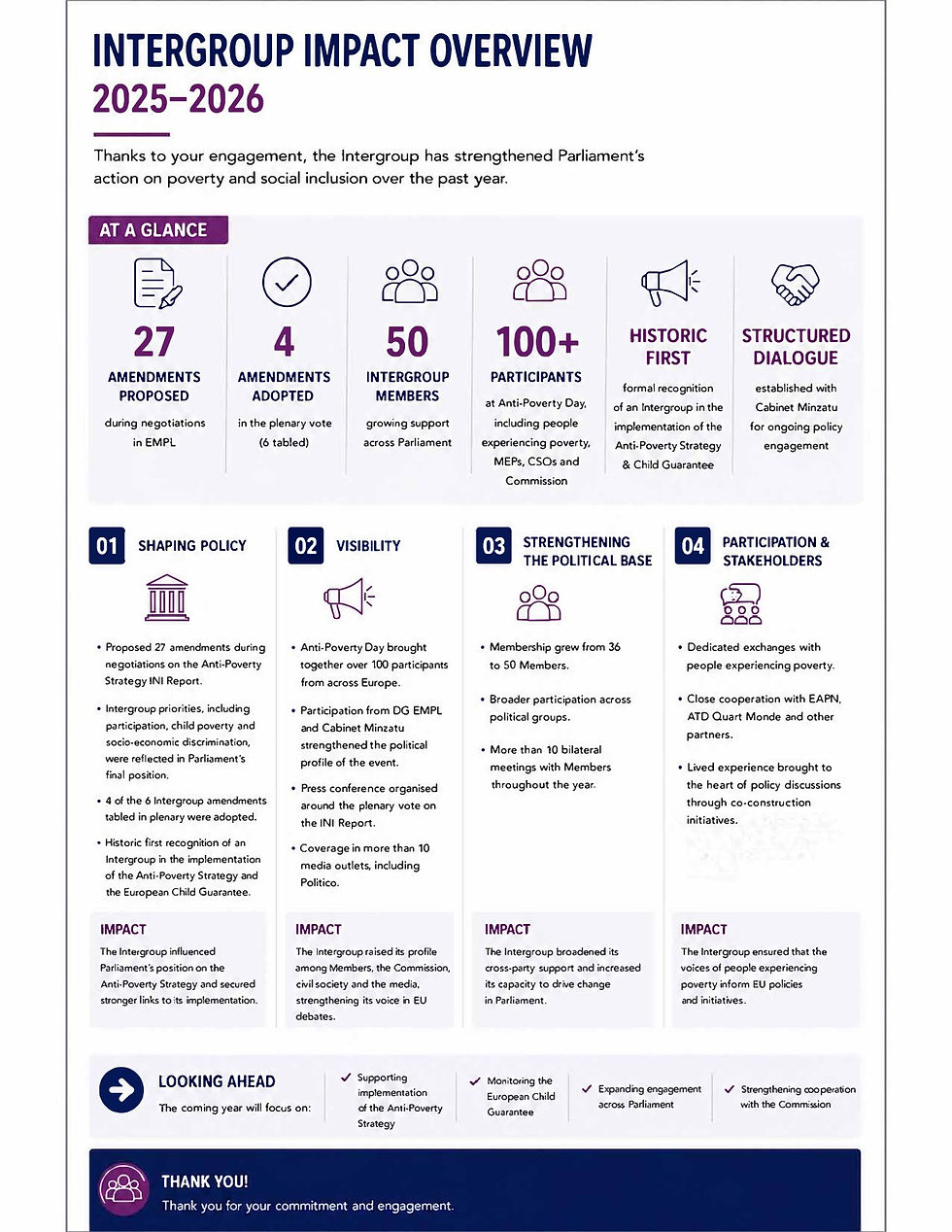
Over recent months, the European Parliament’s Intergroup on Fighting Poverty has been in close dialogue with the Commission to push for stronger action on participation, socio-economic discrimination, renewed urgency in addressing child poverty, and closer alignment with the lived realities of people and families experiencing poverty. I look forward to working with Colleagues across political groups and contributing new ideas to the EU’s first Anti-Poverty Strategy that help build a more socially inclusive and family-friendly European Union.
As Executive Vice-President Roxana Mînzatu highlighted during the debate in Parliament the Commission intends to work closely with the European Parliament’s Intergroup on Fighting Poverty on the implementation of the EU’s first Anti-Poverty Strategy. This cooperation is now being structured and we look forward to continuing our work with Executive Vice-President Roxana Mînzatu and her cabinet to ensure that this strategy delivers tangible improvements in people’s daily lives across Europe.
Fighting against poverty intergroup - ROADMAP
The European Parliament’s Intergroup on Fighting Poverty focuses on the following priorities all contributing to the EU anti-poverty strategy that we want to co-construct with the European Commission:
1. Definition of poverty and effective participation of people in poverty:
A deeper understanding of poverty, its root causes and its effects can be a cornerstone of work done in the intergroup. To provide a solid basis for such an understanding, and spread the knowledge that poverty is far more than simply a material and economic state, a work need to be done based on researches such as The Hidden Dimensions of Poverty conducted by ATD Fourth World and Oxford University.
An effective participation of people experiencing poverty aiming at the active involvement of people in poverty, ensuring their voices shape policy, not just through consultation but co-construction : nothing about them without them.The participation of PeP will be the cornerstone of our intergroup but the aim of the intergroup is bigger: We want to ensure participation in the development of the EU anti-poverty strategy and throughout the development of all kinds of EU policies.
This approach empowers those affected and enhances policy outcomes by addressing overlooked and interdimensional aspects of poverty.
2. Assessing impacts on poverty and inequalities / social mainstreaming:
The EU Anti-Poverty Strategy must include assessments of how all policies affect poverty and inequality reduction, using equality and human rights impact assessments (EQHRIAs) to ensure social rights are safeguarded. In particular, the strategy must ensure that throughout EU policies, the impacts on those in extreme poverty must be evaluated and countered.
The EU budget tools (MFF, ESF+) are of paramount importance to ensure the adequate funding of the fight against poverty across the EU. The intergroup aims at having an impact on the discussions around those tools.
3. Access to social services and socio-economic discrimination:
The right to access to essential services such as housing, water, sanitation, energy, transport, health, education, culture, digital communication and financial services should be guaranteed for everyone. Moreover, it is necessary to complete and improve the support systems for training, job search and the integration into employment of families in precarious circumstances. The 2010 European Quality Framework for Social Services and the EU non-discrimination legislation should be improved by explicitly prohibiting discrimination based on socio-economic status and addressing digitization challenges that hinder access to services for low-income individuals (AI and data-mining practices). Specific attention should be paid to most vulnerable groups experiencing systemic barriers, such as the Roma community.
4. Future of the Child Guarantee: as the number of children living at risk of poverty and social exclusion is still steadily growing, the intergroup will focus on the reinforcement and increase of the European Child Guarantee, among which the issue of housing, right to education
and culture, healthcare, nutrition, as well as children in alternative care among which those suffering from institutional mistreatment for reason of discrimination and Fighting Against Poverty Intergroup - 29/01/2025
socio-economic discrimination. Link to this, support for single-parent families also needs to be improved.
5. Fair/Adequate income: as the EU has adopted its directive on minimum wage, a directive on minimum income and exploration work on basic income are still needed to ensure that no one is doomed to live in indignity.
6. Just transitions: the poorest carry the least responsibility of CO2 emissions and further destruction of the environment and yet the first ones to suffer the consequences. Precarious workers are most often the first victims of heatwaves or chemicals while the poorest live in areas with the highest environmental hazard. In an increased digital world, digital technologies and training should also be accessible to everyone. This intergroup will aim at promoting ways to ensure just transitions that really leaves no one behind.


Comments